Goal: change a weapon's ammunition and see it in the running game Time: about an hour, most of it waiting for the game to load You need: Halo Campaign Evolved on Steam (Windows), and a text editor
This walks the whole path, from a clean install to a value you changed showing up on the HUD. It is the same route the project took to get there the first time, with the dead ends removed.
By the end you will have done this:
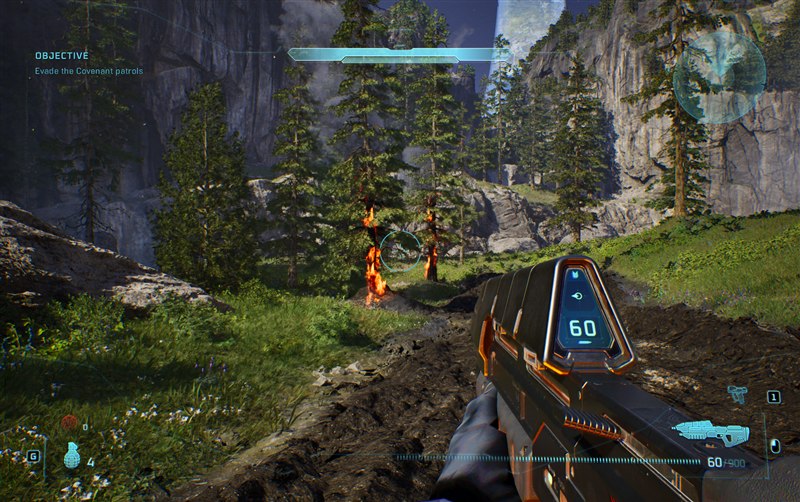 The assault rifle with a 900-round reserve, up from the shipped 324
That 900 is not a number the shipped game contains.
How the game stores its data
Worth two minutes before touching anything, because it explains why the steps are what they are.
Halo Campaign Evolved is Unreal Engine 5 wrapped around Blam, the original Halo engine, which still runs the simulation. Weapons, vehicles and bipeds are tags — the same tag format Halo has used since 2001 — and the UE5 side treats each one as an opaque binary blob it hands to Blam.
Those tags ship inside UE5 IoStore containers: a .utoc index paired with a .ucas data file,
in Meteorite/Content/Paks. Each tag is two chunks:
| Chunk type | Holds |
|---|---|
1 — ExportBundleData | the cooked UE5 package header, ~3.6 KB |
2 — BulkData | the Blam tag itself — the part you want to edit |
To change a weapon you replace its type-2 chunk. You do that with an override container: a tiny
.utoc/.ucas pair holding just your chunk, which the loader prefers over the shipped one.
The rest of this guide is the mechanics of that.
Step 1 — Install the tooling
mjolnir is the command line that reads, inspects and edits tags. It runs on
Windows, Linux and macOS.
# Windows
scoop bucket add mjolnir https://github.com/devnull9090/mjolnir-core
scoop install mjolnir
# macOS and Linux
brew tap devnull9090/core https://github.com/devnull9090/mjolnir-core
brew install mjolnir

# or, on Debian/Ubuntu and Fedora/RHEL respectively
sudo dpkg -i mjolnir_*_amd64.deb
sudo rpm -i mjolnir-*.x86_64.rpm
None of those? Take the archive for your platform from the
latest release,
unpack it anywhere, and put that folder on your PATH. The Linux binary is
statically linked, so it runs on any distribution without installing anything
alongside it. Either way, check it landed:
mjolnir --version
You need this only if you are changing the tool itself, or if you want a build of something that has not been tagged yet. It needs a Rust toolchain.
git clone https://github.com/devnull9090/mjolnir-core
cd mjolnir-core
cargo build --release -p blam-cli
That gives you target/release/mjolnir. The rest of this guide writes mjolnir;
if you built it, that means target/release/mjolnir.
Optional but recommended, since it turns a twenty-minute manual test loop into a two-minute one:
.\scripts\install-bridge.ps1
That installs a UE4SS mod letting tools drive the running game — launch it, start a mission, read
values out of live objects, take screenshots. See game_automation.md.
It is Windows-only.
Where the game is
Every command below needs the Paks folder. Set it once and the rest of the guide
just works:
# Windows
$env:HCE_PAKS = "C:\Program Files (x86)\Steam\steamapps\common\Halo Campaign Evolved\Meteorite\Content\Paks"
# Linux — the game is a Windows title that runs under Proton, but its files sit
# in the ordinary Steam library, unencrypted and readable
export HCE_PAKS="$HOME/.steam/steam/steamapps/common/Halo Campaign Evolved/Meteorite/Content/Paks"
If Steam keeps your games on another drive, look for the library in
~/.steam/steam/steamapps/libraryfolders.vdf. A Flatpak Steam puts everything
under ~/.var/app/com.valvesoftware.Steam/.
On macOS the tool runs, the game does not. Halo Campaign Evolved is a Windows title with no macOS build, so there is no local install to point at. The macOS binary is for reading and editing container files you copied from a machine that does have the game — useful for authoring, not for playing. Everything up to building the container (Step 6) works; installing it and seeing it in game need the machine the game is on.
Step 2 — Find the tag you want
Tags are grouped by type. List the groups:
mjolnir groups --paks "<install>/Meteorite/Content/Paks"
then list the tags in one:
mjolnir list --paks "$PAKS" --group weapon
Weapons live under objects/weapons/, so the assault rifle is
objects/weapons/rifle/assault_rifle/assault_rifle-weapon.
About
--oodle. The shipped containers are Oodle-compressed, and this game links Oodle statically so it ships nooo2core_*_win64.dll. You do not need one: a decoder is built in, and it is what runs by default. If you happen to have a DLL — any UE5 install has one underEngine/Binaries/DotNET/AutomationTool, most UE4-era games underEngine/Binaries/ThirdParty/Oodle/Win64— pass--oodle <path>and decoding runs about four times faster. The bytes are identical either way.
To see a tag's fields and current values:
mjolnir values --paks "$PAKS" --group weapon --tag assault_rifle-weapon --depth 3
Field paths are what you saw printed, so magazines[0].rounds loaded maximum is a magazine's
capacity. Two ways to browse instead of reading a wall of text: the
tag browser on the hub, or apps/tag-editor, the local
Guerilla-style GUI.
Step 3 — Understand the ammo fields before changing them
This is where the first attempt went wrong, so it is worth being explicit. Print your own tag's magazine block before changing anything:
rounds total initial             = 180
rounds total maximum             = 360
rounds loaded maximum            = ?      <- magazine capacity
runtime rounds inventory maximum = 324    <- the reserve the HUD shows
rounds reloaded                  = 36     <- how many rounds a reload transfers
rounds reloaded is the trap. A reload moves a fixed number of rounds into the magazine
rather than filling it. Raise rounds loaded maximum to 200, leave rounds reloaded at 36, and
your reloads still add 36 — the magazine creeps up over several reloads and it looks like nothing
happened. Raise both and one reload gives a clean answer.
rounds loaded maximumis left as?deliberately: the copy this project measured already carried an earlier edit, so its shipped value was never read. Observed reloads reached 68 with the stock tag in place, and a reload cannot exceed capacity, so it is at least that. Read yours rather than trusting a number here — which is the general rule for every field.
So change these together:
| Field | To | Why |
|---|---|---|
rounds loaded maximum | 99 | magazine capacity |
rounds reloaded | 99 | so one reload fills it |
runtime rounds inventory maximum | 900 | the reserve on the HUD |
rounds total maximum | 900 | the cap the reserve counts toward |
rounds total initial | 900 | what you start with |
Step 4 — Make the edit
With the GUI
apps/tag-editor is a Guerilla-style browser: open a group, pick a tag, navigate to
magazines → [0], change the values, and export the patched tag. Good for exploring, since you can
see field names and types without knowing the path in advance.
With the CLI
One field per invocation, chaining the output of each into the next:
mjolnir set --paks "$PAKS" --oodle "$OODLE" \
  --group weapon --tag assault_rifle-weapon \
  --field "magazines[0].rounds loaded maximum" --value 99 \
  --out ar-1.tag
Every edit reports what moved:
  field    magazines[0].rounds loaded maximum  [short integer]
  before   200
  after    99
  file     32620 bytes, unchanged length true
  walk     7269 of 7269 bytes consumed
  differs  1 byte(s) from the original
Read those last three lines every time. walk … consumed means the patched tag still parses
exactly; differs 1 byte(s) means the edit touched its field and nothing else. If either looks
wrong, stop.
Editing a tag file directly
Reading the containers no longer needs a DLL, so this is no longer a workaround — just the way to work on a tag that is already a file, including the uncompressed payload inside an override container you built earlier:
mjolnir tag-file --file ar.tag                                  # print every field
mjolnir tag-file --file ar.tag --field "magazines[0].rounds reloaded" --value 99 --out ar-2.tag
A tag's layout comes from its own header rather than from any external definition, so bytes on disk are enough.
Step 5 — Keep the payload the same length
The single most important rule in this guide.
The UE5 package header records the payload's length, and the two have to agree. Fixed-width fields — integers, reals, enums, flags — edit in place and the length never changes. Strings and block elements resize it, and then you also have to rewrite the package header chunk, which means a two-chunk container and a lot more that can go wrong.
Every field in step 3 is a short integer, so the payload stays 32,620 bytes and you need exactly
one chunk. Confirm before continuing:
mjolnir tag-file --file ar-final.tag | head -2
If the byte count differs from what you started with, you changed a variable-width field. Set it back.
Step 6 — Build the override container
mjolnir pack --paks "$PAKS" --oodle "$OODLE" \
  --group weapon --tag "assault_rifle-weapon" \
  --set "magazines[0].rounds loaded maximum=99" \
  --set "magazines[0].rounds reloaded=99" \
  --set "magazines[0].runtime rounds inventory maximum=900" \
  --out-dir <somewhere>
pack reuses the chunk ID straight out of the shipped index — no ID has to be derived — then reads
its own output back through the ordinary reader before writing anything.
Was a known bug, now fixed. The perfect-hash table
packwrites used to be correct only for a container holding one chunk; a second defect then spilled every chunk at power-of-two chunk counts, so a four-tag mod silently did nothing. Both were fixed (2026-08-01 and 2026-08-02) andpacknow refuses to write a container it cannot resolve through the perfect hash alone. Containers may hold any number of chunks. Seeiostore_packaging.md.
Step 7 — Install it
Copy three files into <install>/Meteorite/Content/Paks/:
pakchunk999-MJOLNIR-Windows_P.utoc     your index
pakchunk999-MJOLNIR-Windows_P.ucas     your data
pakchunk999-MJOLNIR-Windows_P.pak      a 339-byte stub, copied from any shipped stub .pak
Three things about those names matter:
- The
_Psuffix is required. It is UE's patch-container convention, and without it the shipped chunk wins. This was the single hardest thing to find. - The
.paksibling is required. Containers without one are never discovered. Several shipped containers pair a 339-byte stub.pakwith a large.ucas, so copying a stub is normal. - The number confers nothing.
pakchunk999is not a priority.
Nothing shipped is modified. Deleting those three files reverts the game completely, and Steam's Verify integrity of game files is the backstop.
Step 8 — See it work
Launch, start a mission, and look at the HUD. The reserve should read 900 immediately:
900 rounds in reserve
Then reload. The magazine fills to 99 in one press, and the reserve drops by exactly what it took:
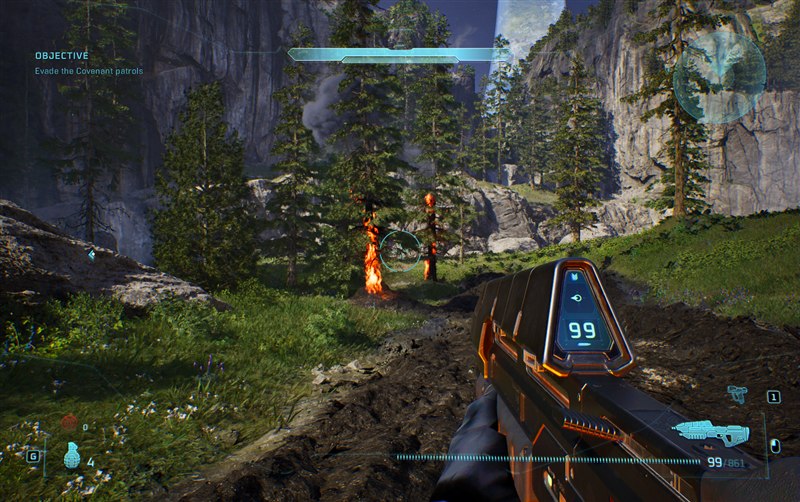 A 99-round magazine, with 861 left in reserve
99 in the magazine, 861 in reserve — 900 less the 39 it took to top up from 60. That arithmetic working out is the confirmation: it is not a HUD quirk, the simulation is using your numbers.
With the bridge mod installed, the whole loop is scriptable:
node tools/mcp/game/cli.mjs launch
node tools/mcp/game/cli.mjs input '[{"key":"Enter"},{"wait":16000},{"key":"Enter"},{"wait":30000}]'
node tools/mcp/game/cli.mjs shot hud.png
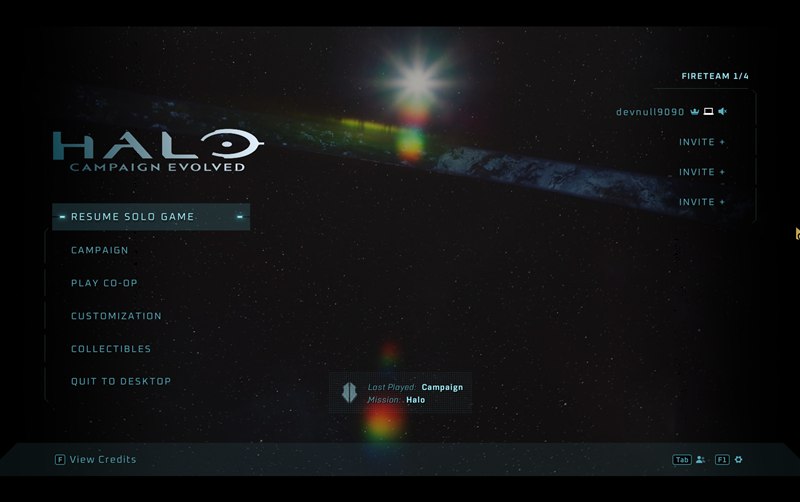 The main menu, captured without the window ever taking focus
When it does not work
The game loads but nothing changed. Most likely the _P suffix or the stub .pak. Check all
three files are present and named identically apart from the extension.
You spawn holding the pistol and cannot switch weapons. Your tag is being loaded, and it is
malformed — the weapon failed to build and the game fell back. This is a useful signal, not a
mystery: the override is working and the tag is wrong. Re-run mjolnir tag-file --file on it and
check the walk consumes every byte.
Ammo looks almost right but not what you set. Re-read step 3. It is nearly always
rounds reloaded.
The game crashes a couple of minutes into a load. If you used a console open command to jump
straight to a level from the main menu, that is the cause — it skips the setup the campaign flow
performs. Start missions through the menus.
Where to go next
tag_editing_guide.md— the editing model in depthtag_body_format.md— how a tag is laid out on diskiostore_packaging.md— how the container work was proven, including what is still unsolvedgame_automation.md— driving the game from a scriptblam_console.md— the classic Blam console, wired to the Unreal console
A closing caution. The evidence in this project comes from measuring the running game, not from documentation, because there is none. Several conclusions here replaced earlier ones that were wrong in ways that looked right at the time. If something you observe contradicts this guide, trust what you observed and please open an issue.