Goal: repaint something in the game and see it in your own hands
Time: about ten minutes, most of it spent painting
You need: Halo Campaign Evolved installed, and either the tag editor or the
mjolnir command line
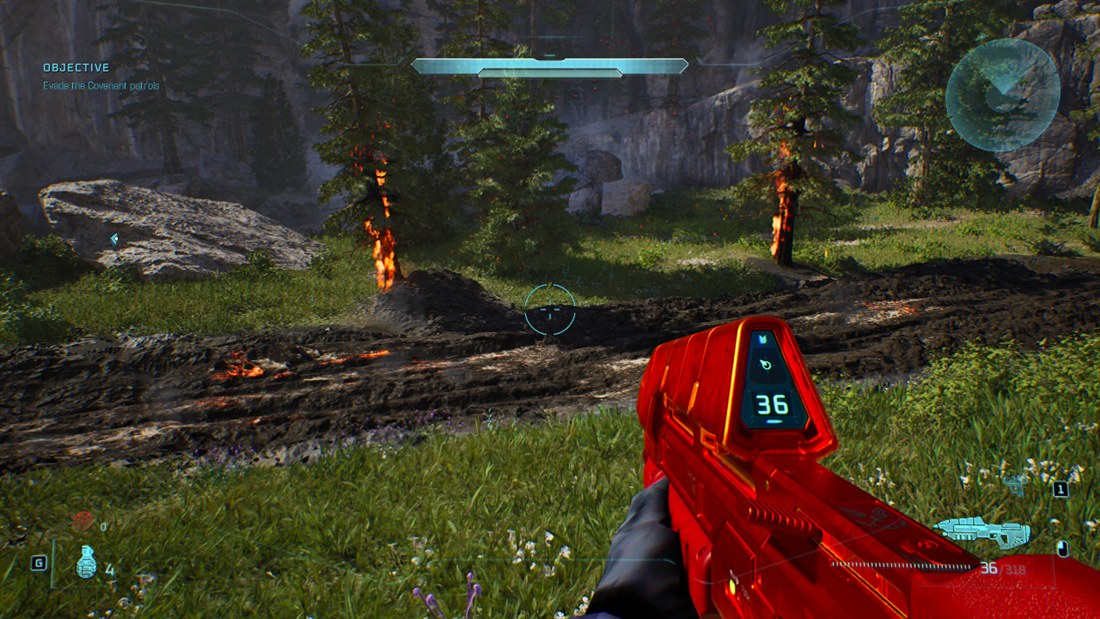 The assault rifle wearing a swapped albedo map
That rifle is the shipped model, the shipped material and the shipped UVs. The only
thing that changed is the pixels in one .ubulk chunk — and the ammo counter still
reads correctly, which is the point: a swap moves nothing.
For why the cooked format looks the way it does, see
ue_texture_format.md. This page is about using it.
Two ways to do this
The tag editor is the shorter road, and the one to take if you are already building a mod: a swap becomes part of your mod project alongside your tag edits, so one Test in game covers all of it and one archive ships all of it. Jump to In the tag editor.
The command line builds a standalone override container for one texture, with nothing else attached. It is the better tool for trying something quickly or for scripting a batch. That is the walkthrough in sections 1–5 below.
Both routes run the same encoder and the same safety checks — the editor calls straight into the crate the CLI uses.
Before you start
Nothing shipped is ever modified. mjolnir texture swap reads the installed
containers read-only and writes a new override container that you drop beside them.
Undoing a swap is deleting three files, and Steam's Verify integrity of game files
is the backstop.
Exported textures are copyrighted game content. Keep them local. Share the
override container only with people who own the game — and see
making_your_first_mod.md for the archive format the hub
validates.
$env:HCE_PAKS = "C:\Program Files (x86)\Steam\steamapps\common\Halo Campaign Evolved\Meteorite\Content\Paks"
An oo2core_*_win64.dll in $env:OODLE makes reading about four times faster but is
optional; without it the built-in decoder reads the same bytes.
Why this works at all
A cooked texture's payload is a fixed jigsaw. A virtual texture is a set of
border-padded tiles at recorded offsets; a classic chain is mips concatenated in
order. Both are addressed by offsets stored in the .uasset.
The trick is that re-encoding an image at the shipped dimensions and pixel format
produces a payload of exactly the shipped byte size. DXT1 at 6144×1024 is 3,145,728
bytes whatever the picture is. So every offset the metadata holds stays valid, and a
swap is not a re-cook — it is replace the bytes of one chunk. For a virtual texture
the .uasset is not touched at all.
That is also why the swap survives a game update better than you might expect: it addresses the chunk the game already asks for, by the ID read out of the shipped index. If an update re-cooks the texture at a different size, the swap stops applying rather than corrupting anything — rebuild it and it lines up again.
1. Find a texture
mjolnir texture list --filter AssaultRifle/default/Textures --detail
--detail reads each header and reports what is really there:
  6144x1024   PF_DXT1          virtual  12 mips  .../T_rifle_assaultrifle_default_D
 12288x2048   PF_BC5           virtual  12 mips  .../T_rifle_assaultrifle_default_N
  3072x512    PF_BC7           virtual  12 mips  .../T_rifle_assaultrifle_default_Masks
 12288x2048   PF_BC7           virtual  12 mips  .../T_rifle_assaultrifle_default_ORME
The suffix tells you what each map is for. _D is the albedo — the base colour, and
the one to change for a repaint. _N is the normal map (surface bumps), _ORME packs
occlusion/roughness/metalness/emissive into channels, and _Masks drives the
material's tinting. Start with _D. Editing _N or _ORME as if they were
pictures will make the surface behave strangely, because they are data, not images.
mjolnir texture info --asset <substring> prints the whole cooked layout when you want
to see it — tile grids, chunk sizes, where each mip lives.
2. Export it
mjolnir texture export --asset AssaultRifle/default/Textures/T_rifle_assaultrifle_default_D --out ar.png
--asset is a substring and it refuses an ambiguous one rather than guessing — the
bare name T_rifle_assaultrifle_default_D matches the HP_Omen skin too, so enough of
the path has to come along to single one out. The error lists the matches.
That writes the top mip as a PNG. It is an atlas: every part of the rifle laid out flat, so an area you paint maps to wherever that area sits on the model.
3. Paint it
Any editor. The only rule that matters is do not move anything — paint over the atlas, keep the layout. Moving a panel moves it on the gun.
Size is not a rule: the replacement is resampled to the shipped dimensions, so a smaller image works (it will just be softer). Matching the exact size gives the sharpest result.
The screenshot above was made by pushing the albedo's luminance through a warm ramp, which recolours everything while keeping every panel line and decal — a good first swap, because if the UVs are still right you can see it immediately.
4. Swap it
mjolnir texture swap --asset AssaultRifle/default/Textures/T_rifle_assaultrifle_default_D \
  --image ar.png --out-dir out --preview check.png
  shipped  6144x1024 PF_DXT1
  image    6144x1024 (exact)
  rewrote  12 mip(s), 3585176 of 4818220 payload bytes changed
  readback mean channel error 0.92 / 255
Every mip is regenerated, not just the top one — otherwise the rifle would revert to its shipped colours as you backed away from it.
Read the readback line. The command decodes the payload it just wrote and
compares it against the image that went in. Block compression costs a couple of levels;
a tile written to the wrong offset costs dozens. Anything above 12 fails the command
rather than shipping a corrupt asset. --preview writes that decode out as a PNG so
you can look at it yourself.
5. Test it in game
Copy the three files into your Paks folder:
cp out/pakchunk999-MJOLNIR-texture_P.* "$HCE_PAKS/"
pakchunk999 mounts after everything shipped, and the _P suffix makes it a patch
container — that is what wins the chunk lookup. The .pak is a discovery stub; a
container without one is never mounted. Then launch the game and go look at the thing
you painted.
To undo it, delete those three files. That is the whole uninstall.
In the tag editor
The editor treats a repaint as one more thing a mod changes, next to its tag edits and scripts. There is no separate container to manage and nothing to copy by hand.
- Open or create a mod project in the MOD panel. A swap has to be saved somewhere, so Replace… stays greyed out until a project is open — the button's tooltip says which of the two reasons is stopping it.
- Open the texture, from the TEXTURES list or by walking to it in FILES.
- Export PNG… to get the shipped atlas, and paint it exactly as in section 3 — same rules, same atlas, same warning about moving things around.
- Replace… and pick your PNG. The editor re-encodes every mip, checks the payload came out the same length, and decodes it back to compare against what you handed it. On a large virtual texture this takes a few seconds.
What you see afterwards is the readback — the payload decoded again, which is what the game will really draw, block-compression losses and all — with the same numbers the CLI prints:
This mod replaces this texture. Re-encoded 12 mips; 4,180,992 of 4,818,220 payload bytes changed; readback error 2.41 / 255.
The swap now appears in the mod's change list, and Test in game and Export .mjolnir archive bake it along with everything else. Revert in the texture header drops it.
Your PNG is stored in the project folder at textures/<path>.png, and
edits.json records which textures have one — the same arrangement as .hsc
script files. That means the recipe stays readable and re-encodes against
whatever the player's install ships, so a game update does not bake a stale
payload into your mod. It also means the PNG is the file under version control,
not a cooked blob.
What can be swapped
| Format | |
|---|---|
PF_DXT1, PF_DXT3, PF_DXT5 | yes |
PF_BC4, PF_BC5 | yes |
PF_B8G8R8A8, PF_G8, PF_A8 | yes |
PF_BC7, PF_BC6H | not yet — needs a BPTC encoder |
Both virtual textures and classic mip chains are supported. PF_BC7 is a real gap:
it is the second most common format in the game (1209 textures, against DXT1's 1867),
and it covers most _ORME and _Masks maps. Albedo maps are usually DXT1 or DXT5,
which is why repaints work today.
Refused rather than approximated, in both cases:
- A format with no encoder fails the command. A texture written in a format we encode wrongly would be a corrupt asset in a player's install, showing up as garbage pixels rather than an error.
- Cubemaps, arrays and volume textures fail too. One 2D image does not say what the other faces should become, and rewriting one would silently discard them.
- A classic texture that keeps every mip inline in its export has no bulk chunk to replace; the encoder handles it, but neither the command nor the editor can pack it yet.
In the editor, an unsupported format is visible before you pick a file: Replace… is greyed out and the reason sits under the texture's path.
Troubleshooting
Nothing changed in game. Check the file names first — the _P suffix and the
.pak stub are both load-bearing, and a pakchunk number below a shipped one loses.
Close the game before copying: Windows will not let files it holds open be replaced,
so a silent copy failure looks exactly like a swap that did nothing.
If the files are right, re-run texture swap and read the chunk id line — that is
the chunk your container claims. It has to be the asset you meant.
It changed, but the wrong thing. The game ships several skins per weapon under
sibling folders (default/, AssaultRifle_HP_Omen/, AssaultRifle_Twitch/, …). Check
you repainted the one the game actually equips.
The colours are close but not right. Albedo maps are usually multiplied by material
tinting, which is often driven by _Masks. The rifle above reads redder in game than
its atlas does for exactly this reason. Paint to taste against the in-game result, not
the PNG.
readback mean channel error is high. That is the swap refusing to ship something
broken. It means the payload did not decode back to the image that went in, which is a
bug worth reporting with the asset path.
Questions, or something here did not match what you saw? Say so on the Discord — this path is new and reports make it better.